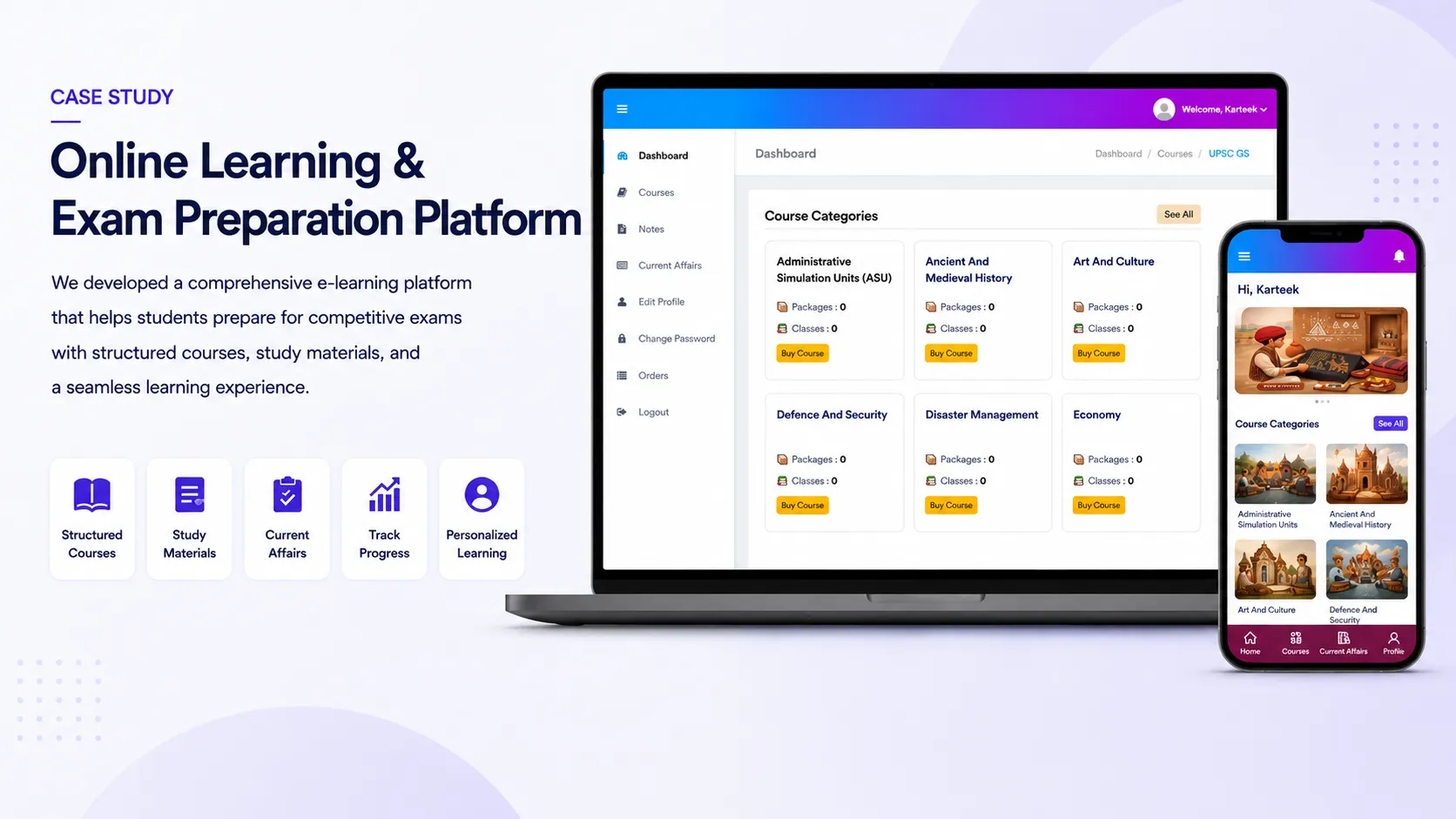
Rapid growth to digital education is now bringing with it a demand for more robust andscalable EdTech platforms that can address tens of thousands of aspirers and high stakes competitive entrance exam aspirants. One of the largest Indian Education Organizations approached Kkeydos to deliver a completely integrated Online Learning Platform Development solution to transform and take their classroom-focused education system to the multi-channel digital world.
To end their patchwork learning environments, Kkeydos developed an enterprise grade web and mobile enabled EdTech platform that offers a unified command center with the ability to discover courses, access structured video and textual course material, access real time current affairs updates, manage student accounts, and process payments from a single centralized interface.
Kkeydos has designed, developed, and successfully deployed a fully end-to-end EdTech ecosystem and extended their client’s learning reach to over 10,000+ new students with:
85% Increase In Student Engagement - Mobile-first responsive design and structured learning content increased the number of daily active students.
100% Centralized Content Administration - All administrative controls for Syllabus Updates, PDFs, Current Affairs, etc were managed through one portal, eliminating manual distribution.
50% Reduction In Onboarding Time - The process of creating a new student account, and accessing/ unlocking learning material post purchase was automated for speedy access.
99.9% Cross Platform Uptime - Reliable cloud hosting capabilities made the platform available to users 24/7 even at peak usage times or during new examination announcements.
The need for focused study plans, ongoing current events updates, and immediate access to teaching tools are inherent in the process of getting ready for the many national and state-level competitive exams. While simple Web pages and printed notes can serve certain purposes, they fail to maintain operational agility and support scalability.
Before they approached Kkeydos with a request for assistance with their platform for exam preparation, our customers were unable to manage these operational bottlenecks:
Fragmented Course Administration – inability to organize their different types of programs and categories of competitive examinations.
Mobile Support – No mobile presence that enables quick access to notes, news items, and study lessons for users when they were on the go.
Manual Process for Purchase Orders – their current procedures are unable to accommodate bulk offline course orders automatically.
No Student Analytics – it was not possible for them to get real-time student enrollment numbers, views of popular categories of classes, or comments from trainees.
A. Enhanced content structure and class design
Multi-level curriculum structures - The content was organized into a well-defined curriculum based on the exam category, subject, learning category, and subtopic.
Dynamic content reservoir - Customers can access study notes and study ebooks by downloading from a safe place.
Real-Time current affairs generator – A custom daily news feed that adheres to competitive syllabus requirements.
B. Integrated mobile & learner’s encounter
Personalized dashboard for learners – A dynamic learner interface that provides them access to active classes, their subscriptions, previous purchases, and performance history.
Seamless course purchase experience – Secure payment gateway embedded for seamless buying; upon purchase, classes are instantly activated automatically.
Synchronized experience across different devices – responsive and adaptable web portal alongside native mobile applications with synchronized data.
C. Centralized governance, security and management structure
Granular role-based control of authorization – Defined permissions levels for content providers, examiners, fiscal support and the system administrator.
Robust login and account administration – Used powerful authentication to avert the illegal selling and sharing of class material to large audiences.
Elastic cloud infrastructure – Developed microservices that the platform was engineered with for future integrations like live classes, automatic mock exams, and academic certifications.
System Transformation: Legacy Learning vs. Kkeydos Custom Engine
Course Organisation & Discoverability
Legacy Learning: Disparate PDFs; unorganised web links; physical in-classroom notes kept offline.
Kkeydos Custom Engine: Hierarchical cataloguing system that helps find any study module in a matter of seconds – based on exam type, subjects, topics, etc.
Access & Content Deliverability
Legacy Learning: Accessed on computers only; loaded slowly, no mobile-readiness.
Kkeydos Custom Engine: Quick Web and Mobile interfaces tailored for easy reading and streaming media no matter where you are.
Course Purchasing & Course Registration
Legacy Learning: Cash / DD collection, records maintained manually, delayed course access.
Kkeydos Custom Engine: Pay instantly online through a gateway of your choice, get instant account registration.
Administration & Control
Legacy Learning: Dispersed system components, hundreds of hours needed to release notes due to manual coordination.
Kkeydos Custom Engine: All-inclusive administrator dashboard to post new courses/notes and current affairs with a single click.
We followed a user-centric, process-driven approach towards software engineering to launch the EdTech platform customization:
EdTech Requirements & Process Blueprinting – Sessions to document exam syllabi, students, admin-processes etc
Database & Content Schema Engineering – A database schema structured for optimal and rapid retrieval of digital asset and user-data at high volumes.
UI/UX & Mobile First Prototyping - Lowest latency interface and low-complexity wired flow designed for lengthy reading.
Full stack Development & API Coding - Secured RESTful APIs, Responsive Web dash board and Mobile App framework development.
Security Auditing, load testing and cloud deployment - stress testing for the highest concurrent student numbers. Migrated application in a cloud-native infrastructure environment.
Q1: What is the primary objective of the Online Learning Platform case study?
A: This case study outlines how Kkeydos developed an integrated web and mobile e-learning portal for an Indian education provider in India. Our solution facilitated preparation for competitive exams, delivery of training courses, daily current affairs updates, and enhanced student management for them.
Q2: Is the platform capable of handling multiple competitive exam subjects and categories?
A: Yes. An intelligent multi-tier course structure allows site administrators to categorise learning programs within an infinite hierarchy of exam types, subjects, units, and topics.
Q3: Is the e-learning platform accessible via both desktop browsers and mobile applications?
A: Yes. Kkeydos ensures a synchronized web and mobile application presence, which enables students to smoothly access their learning course material, notes and news on desktop systems or smartphones.
Q4: How is the flow of daily current affairs updates managed through the portal?
A: A dedicated current affairs content publishing section enables site administrators to push out daily current affairs digests and updates relevant to exam takers and quiz links into the student dashboard.
Q5: Does the e-learning portal process online course purchases and student enrollment automatically?
A: Yes. Kkeydos integrated secure payment gateways which allows for instant processing of all study course package sales and automatic granting of course content access for students right after payment.
Q6: Does the learning platform provide security against content piracy and unauthorized sharing?
A: Yes. We provide RBAC (Role-Based Access Control), encrypted session token security and strict account security standards to ensure course material and content intellectual property protection from third-party access and misuse.
Q7: can live virtual classes and mock test sessions be added to the portal later?
A: Yes. Kkeydos have implemented an open micro services architecture allowing for straightforward integration of future features such as live video streaming classrooms, interactive online tests and mock exams, digital certification issuance, and AI powered student learning analytics when ready.
Q8: How is the backend administrative interface beneficial for the education organization?
A: An intuitive content management console allows all educational organisation stakeholders to manage their students, publish lecture content, update course fee- structures, generate sales reports, and maintain an up-to-date study curriculum from one administrative console.
Q9: Who owns the IP and source code of the custom e-learning platform?
A: The end-consumer is provided with full ownership on our developed custom code, source code,database architecture, systems design, and course content materials on successful project closure.
Kkeydos does not charge any ongoing software platform license fees.
Q10: How can I get in touch with Kkeydos to get my custom online teaching portal developed?
A: We invite all our EdTech solution seekers to fill in their requirement details and submit a request for a free technical consultation and custom development quotation at https://www.kkeydos.com/contact-us




You Dream IT we develop IT
All Rights reserved @ Kkeydos