Building a SaaS product is a major investment, but the cost can vary significantly depending on what you want to build.
A simple SaaS MVP with a few core features may cost a few lakhs, while a complex platform with multiple user roles, integrations, AI, analytics and enterprise-level security can require a much larger budget.
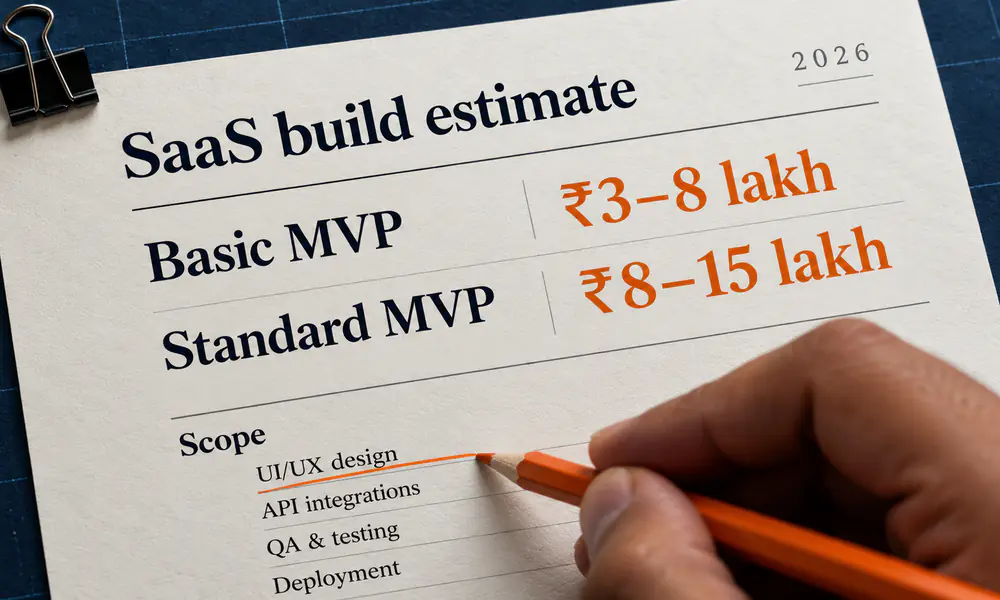
In 2026, a practical starting range for SaaS development in India is approximately ₹3 Lakhs to ₹1 Crore+, depending on the scope and complexity of the product.
SaaS Development Cost in 2026
| SaaS Product | Estimated Cost |
|---|---|
| Basic MVP | ₹3–8 Lakhs |
| Standard SaaS MVP | ₹8–15 Lakhs |
| Advanced SaaS | ₹15–35 Lakhs+ |
| Complex SaaS Platform | ₹35 Lakhs–₹1 Crore+ |
These are indicative ranges rather than fixed prices. Your actual SaaS development cost will depend on the features, technology, integrations, design and level of scalability required.
What Determines SaaS Development Cost?
Several factors influence the final cost of developing a SaaS application.
1. Features and Functionality
The number and complexity of features have a direct impact on development time.
For example, a basic CRM may include:
- Lead management
- Customer profiles
- Tasks
- Dashboard
- Reports
- Admin panel
A more advanced CRM could additionally include:
- AI lead scoring
- WhatsApp integration
- Email automation
- Sales forecasting
- Workflow automation
- Advanced analytics
- Mobile applications
The second product naturally requires more development effort.
2. UI/UX Design
A SaaS product needs to be easy to understand and use.
The development process may include:
- User journey planning
- Wireframes
- UI design
- Responsive layouts
- Design system
- Interactive prototypes
Good UX is particularly important when your SaaS product will be used regularly by business teams.
3. User Roles and Permissions
A SaaS platform may have different types of users.
For example:
- Admin – manages the platform.
- Manager – manages teams and reports.
- Employee – performs daily tasks.
- Customer – accesses specific services or information.
Each role may require different screens, permissions and workflows, increasing development complexity.
4. Third-Party Integrations
Modern SaaS products often connect with other platforms.
Examples include:
- Stripe
- Razorpay
- PayPal
- Microsoft
- Email services
- SMS platforms
- CRM systems
- Accounting software
- AI APIs
Each integration needs development, testing and ongoing maintenance.
5. Multi-Tenant Architecture
If your SaaS will serve multiple companies from one platform, you'll generally need a multi-tenant architecture.
For example, Company A should only see its own customers and reports, while Company B should have completely separate data.
This requires careful planning around:
- Data isolation
- User permissions
- Security
- Database architecture
- Subscription management
How Much Does a SaaS MVP Cost?
For startups, building an MVP can be a practical way to test the market before investing in the complete product.
A SaaS MVP usually focuses on the core problem you're solving.
For example, instead of building a complete CRM with 30 features, the first version could focus on:
- Login
- Lead management
- Lead pipeline
- Customer management
- Tasks
- Dashboard
- Basic reporting
- Subscription billing
Once customers start using the product, you can use their feedback to decide which features should come next.
A focused SaaS MVP can typically start around ₹3–8 Lakhs, while a more feature-rich MVP may cost ₹8–15 Lakhs or more.
How Long Does It Take to Build a SaaS Product?
Development time depends on the size of the product.
| SaaS Product | Estimated Timeline |
|---|---|
| Basic MVP | 6–12 weeks |
| Standard SaaS | 3–4 months |
| Advanced SaaS | 4–6+ months |
| Complex Platform | 6–12+ months |
The timeline usually includes planning, UI/UX design, development, testing and deployment.
Adding more features during development can also increase both the cost and launch timeline.
What Technology Should You Use?
There is no single technology stack that is right for every SaaS product.
Depending on the requirements, a SaaS platform can be built using technologies such as:
- Laravel
- Node.js
- React
- Next.js
- Vue
- Angular
- MySQL
- PostgreSQL
- MongoDB
- AWS
The technology should be selected based on the product requirements, scalability, security and long-term maintenance, rather than simply choosing the newest framework.
How to Reduce SaaS Development Costs
You don't necessarily need to build the entire product on day one.
A better approach is to:
Start with the core problem
Clearly identify what problem the SaaS product solves.
Build an MVP
Focus on the features necessary to deliver that value.
Avoid unnecessary integrations
Add third-party integrations when they provide clear business value.
Plan the architecture properly
A good architecture can make future expansion easier without rebuilding the entire application.
Add features based on customer feedback
Once the product is being used, prioritize features based on actual customer requirements.
SaaS Development Cost: What Should Your Budget Include?
When comparing development proposals, don't look only at the development price.
Check whether the quote includes:
- Product planning
- UI/UX design
- Frontend development
- Backend development
- Database development
- API development
- Payment integration
- Third-party integrations
- QA and testing
- Cloud deployment
- Security
- Documentation
- Post-launch support
Two companies may quote completely different prices because their proposals include different things.
Final Thoughts
The cost of building a SaaS product in 2026 depends less on the word “SaaS” and more on the product you actually want to build.
A focused MVP can help you launch faster and validate your idea without spending your entire budget upfront. Once you understand what customers actually need, you can expand the platform with advanced features, automation, integrations and AI.
Whether you're planning a CRM, ERP, marketplace, AI platform, HR application or another subscription-based product, the first step is to clearly define the problem, users, core features and MVP scope.
At KKEYDOS, we help businesses turn SaaS ideas into custom digital products—from product planning and UI/UX to development, testing and deployment.