Choosing the right software can have a major impact on how efficiently your business operates.
Some businesses choose ready-made software because it is quick to deploy and usually comes with a predictable subscription. Others invest in custom software because they need specific workflows, integrations or functionality that existing products cannot provide.
So which approach is right for your business?
The answer depends on your requirements, budget, growth plans and how closely the software needs to match your operations.
What Is Off-the-Shelf Software?
Off-the-shelf software is a ready-made product designed for a broad group of businesses.
Examples include:
- CRM platforms
- Accounting software
- Project management tools
- HR platforms
- Marketing automation tools
- Inventory management software
You normally subscribe to the platform, configure some settings and start using it.
Advantages
The biggest advantage is speed. You don't need to spend months building the software before your team can use it.
Other benefits include:
- Faster implementation
- Predictable subscription pricing
- Existing features
- Regular updates
- Established support
- Lower initial investment
For businesses with standard processes, this can be a practical approach.
What Is Custom Software?
Custom software is designed specifically for a business or a particular business model. Instead of changing your processes to fit the software, the software is designed around your processes.
For example, a logistics company may need software connecting orders, drivers, inventory, delivery, billing and reports. If existing platforms cannot handle that workflow properly, custom software can be developed around it.
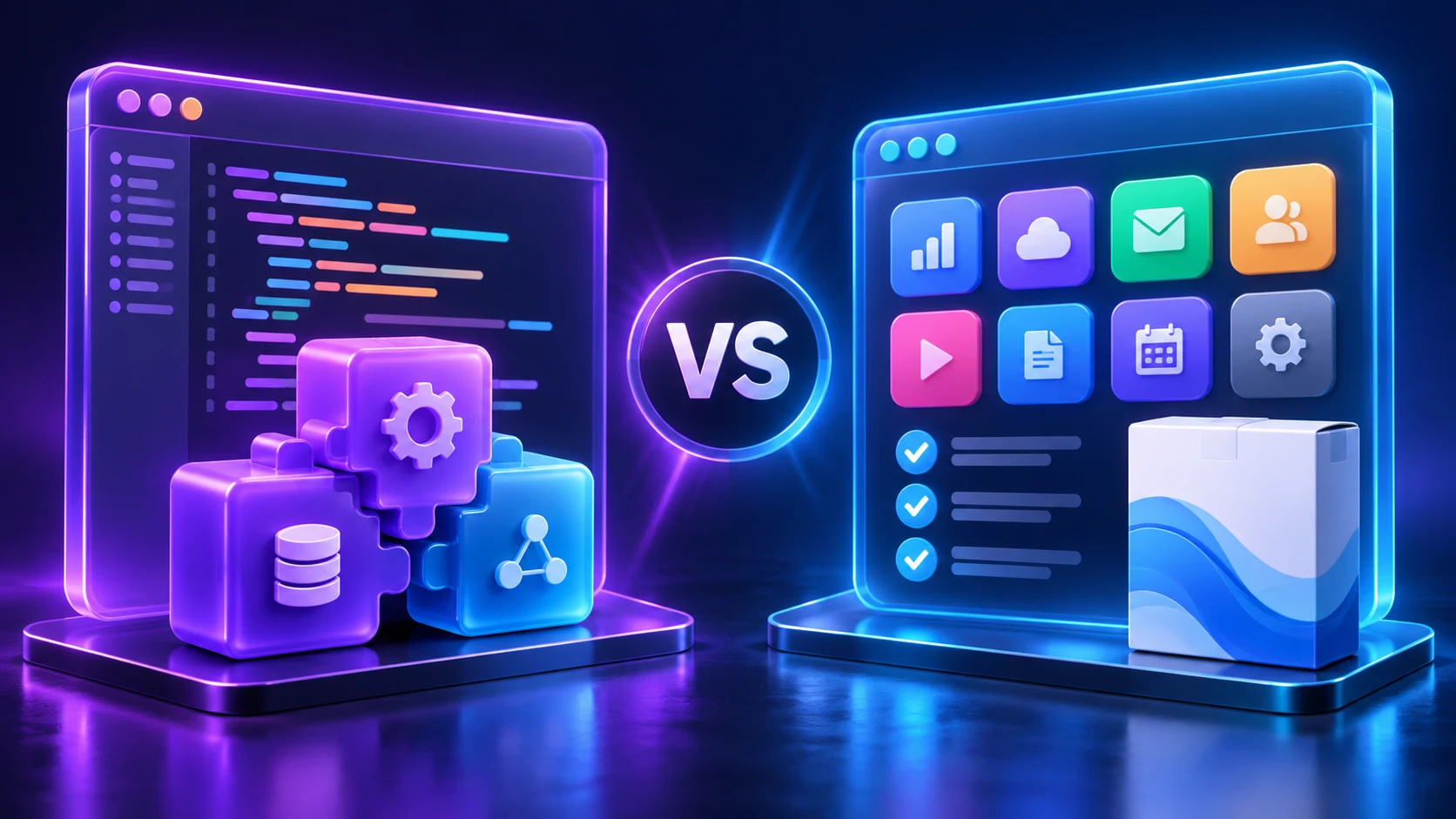
Custom Software vs Off-the-Shelf Software
| Factor | Custom Software | Off-the-Shelf |
|---|---|---|
| Initial cost | Usually higher | Usually lower |
| Customization | High | Limited |
| Development time | Longer | Faster |
| Integrations | Built around requirements | Depends on APIs |
| Scalability | Designed for your needs | Vendor dependent |
| Ownership | Greater control | Vendor controlled |
| Maintenance | Your responsibility | Vendor managed |
When Should You Choose Custom Software?
Custom software may make sense when:
Your processes are unique
If your business has workflows that don't fit standard software, customization can eliminate manual workarounds.
You need multiple systems connected
For example, your CRM, ERP, website, payment gateway and internal systems may need to share data.
You are scaling
Software that works for a small team may become restrictive as your business grows.
Your software is part of your competitive advantage
If your product or workflow is central to how you operate, having more control over the technology can be important.
When Is Off-the-Shelf Software Better?
A ready-made product may make more sense when your requirements are standard and you need to start quickly. For example, a small business may not need a custom CRM if an existing platform already provides everything the sales team needs.
Building software simply because you can isn't necessarily the right decision. The real question is: Will custom software create enough business value to justify the investment?
What About the Cost?
Custom software generally requires a larger initial investment because you're paying for discovery, design, development, testing and deployment. However, software cost should be considered over the long term.
A low-cost tool can become expensive if your team has to maintain spreadsheets, duplicate data or manually move information between systems. On the other hand, custom software can also become expensive if the project is poorly planned or continuously expands beyond its original scope.
A Practical Approach
Before choosing either option, document:
- Your current workflow
- Problems with your existing tools
- Required integrations
- Number of users
- Expected growth
- Must-have features
- Budget
- Long-term requirements
Then compare existing software against those requirements.
Final Thoughts
There is no universal answer to the custom software vs off-the-shelf software question. If your requirements are standard and speed matters, an existing platform may be enough.
If your workflows are unique, your systems need to work together, or your business requires functionality that existing products cannot provide, custom software may be worth considering.
At KKEYDOS, we help businesses evaluate requirements and build custom web applications, SaaS platforms, CRM, ERP and AI-powered solutions.
Have a software idea or business problem to solve? Let's discuss it.